
"Give me five minutes, and I can predict your financial future for the rest of your life."
T. Harv Eker's legendary Millionaire Mind Intensive has transformed the financial lives of millions worldwide. Here's what it actually teaches — and why it still resonates decades later.
That's the bold opening claim behind the Millionaire Mind Intensive (MMI) one of the most attended personal finance seminars in history. Since the early 2000s, MMI has drawn hundreds of thousands of participants across more than 40 countries, sparked bestseller lists, and ignited ongoing conversations about the psychology of wealth.
The premise: your financial future isn't determined by what you know. It's determined by what you believe — deep down, often without realizing it.
40+
Countries Reached
Global footprint of the MMI program
100+
Participants
Hundreds of thousands have attended live events
The Core Idea: Your Money Blueprint
The foundation of MMI is Eker's concept of the financial blueprint — an internal, often unconscious, set of thoughts, feelings, and habits formed in childhood through family, culture, and lived experience.
No matter how much financial education, strategy, or opportunity you receive — if your inner blueprint is set for a low level of wealth, you'll always find a way to self-sabotage back to where your unconscious believes you belong.
This idea bridges the gap between the "hard" skills of finance — investing, budgeting, asset management — and the "soft" inner work that most financial education ignores entirely. It resonates deeply with people who've tried conventional financial advice and still feel stuck.
"Your income can only grow to the extent that you do." — T. Harv Eker, Secrets of the Millionaire Mind
What the Program Actually Teaches
MMI is delivered as a multi-day intensive seminar. The curriculum is immersive by design — lasting mindset change requires more than a book or a lecture. Participants move through a structured process of awareness, confrontation, and reprogramming.
1
Wealth Files
17 mindset contrasts between how wealthy and struggling people approach money, time, and personal responsibility.
2
Root Cause
Analysis Identifying childhood "programs" and inherited beliefs that silently drive financial behavior — and learning to recognize them in real time.
3
Declarations & Conditioning
Verbal and physical exercises used to reinforce new beliefs at a subconscious level — a central, if controversial, component of the Eker methodology.
4
Income Ceiling
Breakthrough Exercises designed to surface and remove the unconscious cap on how much participants believe they're allowed to earn or deserve.
5
Abundance Thinking
Shifting from a scarcity-based worldview to one that sees opportunity, resources, and collaboration as expandable — not zero-sum.
6
Financial Management
A practical money management system built around "JARS" — allocating income into purposeful buckets for living, saving, growing, and giving.
The JARS Money Management System
One of MMI's most actionable takeaways is the JARS system — a straightforward framework for managing income regardless of how much or how little you earn. The power isn't mathematical sophistication. It's the psychological intentionality it instills.
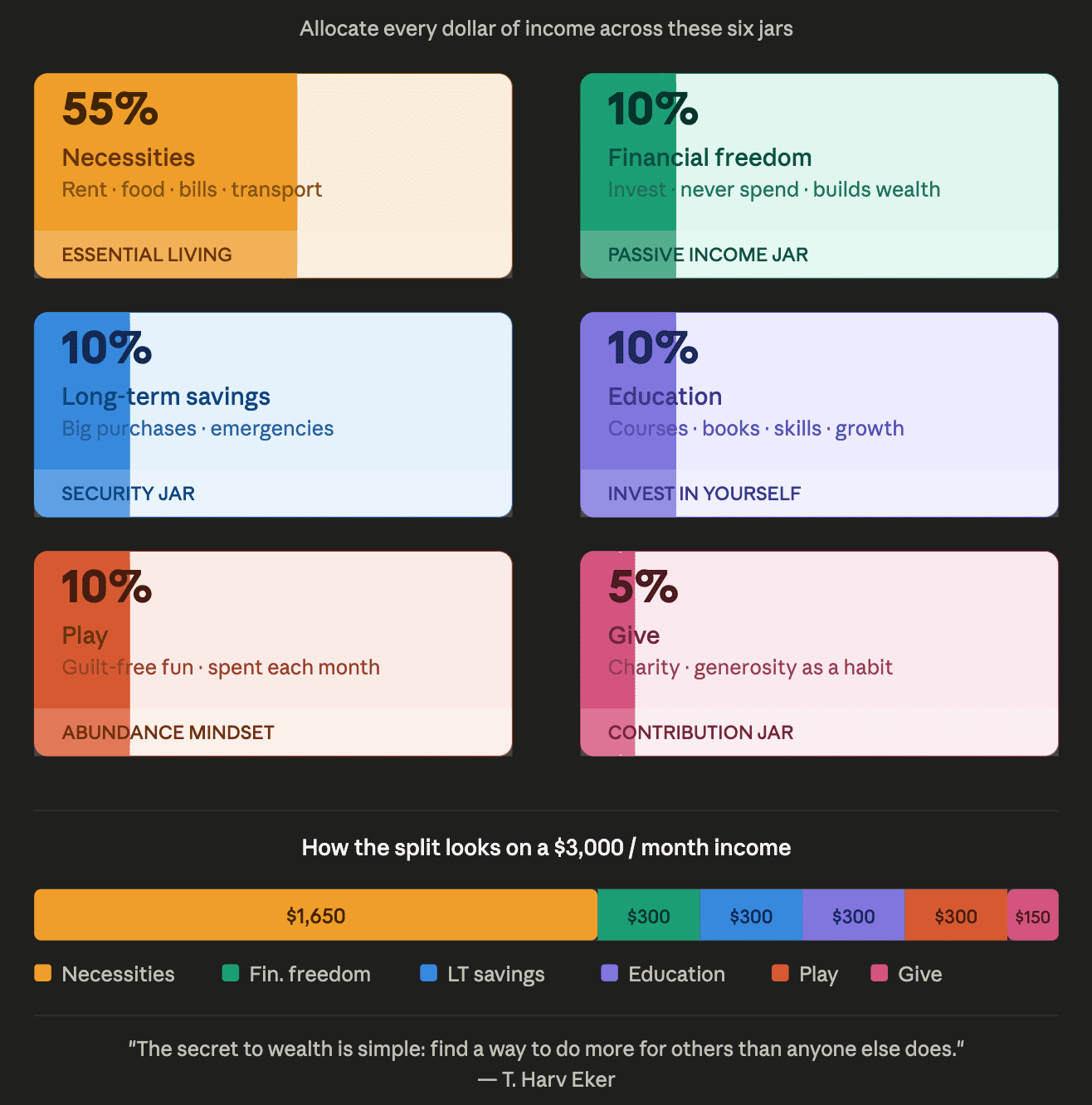
By giving every dollar a defined purpose, participants shift from reactive to proactive financial behavior — building both security and a genuine abundance mindset simultaneously.
Who MMI Is Really For
The program draws a remarkably wide demographic — united not by income level, but by a shared feeling that outer strategies alone aren't working.
Plateaued Entrepreneurs
Business owners who work hard but find their growth mysteriously stalling, despite all the right moves on paper.
High Earners Who Can't Save
Employees with solid incomes who consistently reach month-end with nothing left — and can't figure out why.
People in Debt Cycles
Individuals who have paid off debt only to find themselves back in it — recognizing the pattern is internal, not circumstantial.
Self-Aware Investors
Experienced investors who want to examine what's truly driving their decisions below the surface of strategy and analysis.

What Behavioral Economics Says
Modern psychology and behavioral economics lend considerable support to Eker's foundational premise. Financial decisions are far less rational than we assume — and far more governed by unconscious emotional programming.
Kahneman & Tversky
Nobel-winning research on cognitive biases, loss aversion, and mental accounting confirms that emotional wiring — not logic — drives the majority of financial decisions.
Dr. Brad Klontz — Money Scripts
Financial psychologist at Creighton University, Dr. Klontz formalized the concept of "money scripts" — childhood-learned beliefs that unconsciously drive financial behavior. These align directly with what Eker calls the "money blueprint," providing academic validation for MMI's core premise.
The research conclusion: financial patterns are deeply ingrained, emotionally rooted — and genuinely changeable once made conscious.
Criticisms & Honest Limitations
No program with this reach exists without scrutiny. It's worth approaching MMI with clear eyes about what it is — and what it isn't.
High-Energy Environment
The seminar format is intense by design. Some participants find the energy motivating and transformative; others describe it as overwhelming or emotionally pressured.
Upsell Structure
Participants are regularly invited to enroll in additional paid programs. Critics note this can feel pressure-driven — something to be aware of going in.
Mindset Is Not Enough on Its Own
Structural factors — access to capital, systemic inequality, economic barriers — play a real role in financial outcomes that no inner work can fully override. MMI works best as one component of a broader financial education.
That said, for participants who engage sincerely, MMI consistently produces meaningful shifts in financial awareness — particularly for those who already have the "right" information but remain stuck.

T. Harv Eker: The Man Behind the Method
Eker's personal story forms the backbone of everything he teaches. By his own account, he went from broke to millionaire — multiple times — hitting rock bottom repeatedly before identifying the mental patterns causing him to self-destruct financially.
1
Repeated Failure
Multiple cycles of earning and losing money, prompting deep self-examination of underlying patterns.
2
The Breakthrough
Identified the unconscious beliefs driving financial self-sabotage — and began deliberately reprogramming them.
3
Millionaire in 3 Years
Built and sold a fitness equipment company, achieving millionaire status in under three years by applying his new mindset principles.
4
Secrets of the Millionaire Mind
His 2005 book became a New York Times bestseller, introducing his framework to a global audience.
5
MMI Goes Global
The live intensive program was developed as the experiential companion to his book — creating deep, embodied change that reading alone rarely achieves.

Millionaire Mind Intensive — South Africa 2025
A 3-day live, in-person event brought to South Africa by Success Resources — one of the world's leading personal development event companies. Three cities, three opportunities to attend.
 Durban
 Durban
April 17 – 19, 2026
Johannesburg
 Johannesburg
April 24 – 26, 2026
Cape Town
 Cape Town
June 26 – 28, 2026
Check this out for the event details Millionaire Mind Intensive 2026 South Africa
Is It Worth Attending?
If you approach MMI as an opportunity for genuine self-examination — rather than expecting a financial formula handed to you — most participants find it to be a worthwhile investment of time and attention. The live format creates an environment of focus and peer accountability that's genuinely difficult to replicate through self-study.
The most important thing to bring is an open mind and a willingness to examine uncomfortable truths about the relationship you've built with money over your lifetime. Whether or not every technique resonates, the core question MMI asks is one worth sitting with: